Sunday, 28 January 2024

The appeal - and perils - of working from home


The sad tale of Brittany Pietsch, who filmed herself being fired from her role as an account executive for a US tech company, should be a warning about the need for better management, training and performance assessment of junior staff. Maybe it's also a warning about the perils of trying to lead, manage and train in a world where face-to-face contact  is diminished. My daughter told me about the viral TikTok video that resulted, and while I talked about the importance of being fair, clear and honest when taking away someone's livelihood, she suggested that some managers simply don't like telling their staff that performance isn't good enough and so don't help them improve. So someone at the start of their working career can be left with no clue how to do their job better. It's even harder for managers to mentor, train, help or evaluate junior staff in a hybrid working environment. If, as as is often the case, the managers have home offices (and would like to come into the office one or two days a week at most) while juniors are in flat-shares which encourage going in, say, three or four days a week,  the chances of managers being effective are further reduced. 

Some time before Covid, someone asked me how long I was planning to go on working and I replied, glibly, that I had no intention of stopping but I didn't know how long I wanted to go in for the 7 am morning meeting. My employer's relocation from the City to Canary Wharf and the explosion of low traffic neighbourhoods means that what used to be a 20-minute commute, is now an hour by public transport,  45 minutes by bike (downhill) or 45 minutes by car (on a Sunday morning or before 6:30 am in midweek). The result is that it is now over a year since I last went in for the morning meeting. I go in later instead. 

The shift away from standalone Reuters, Telerate, Quotron or Bloomberg terminals (which were all tiny by comparison to anything you see on a trading desk today) and their replacement with huge banks of screens giving access to multiple applications, reduced human contact on trading floors years ago. The shift away from voice trading and the growth of email and chat, along with regulatory limits to who should have access to what information, has significantly changed the purpose of the cavernous trading floors of the 1980s and 1990s. There's still a strong case for a lot of trading/sales staff to be present on the floor, in order to reduce the risk of (expensive) mistakes, but those old clips of Masters of the Universe lording it over the floor and screaming abuse at everyone, have nothing to do with a modern trading business. 

There is then, little point in my going into work first thing in the morning, and little benefit to being in the office to listen and watch the markets. It has become clear that the only reason to go in at all, is to talk, eat and occasionally drink with other people. Juniors need mentoring and managing, colleagues need to shoot the breeze, bosses need to be helped to say what they really think without hiding behind a Teams connection and clients need ideas. All of these can be done over breakfast, coffee, lunch, tea, drinks or dinner. And the nice thing is that while I like the view of the Wharf from home in the morning, the view from the Wharf is wonderful in the evening... 


Tuesday, 7 June 2022

I sat there and I listened.....but I heard nothing

The debate about the merits of working from an office, or from home, will rage for years rather than months. Younger workers who live in shared accommodation, and need to be seen at work to speed promotion, have obvious incentives to go back. Factory floor workers, people who operate in tight-knit teams, or in people-facing roles, don’t have a choice. For older workers it’s more complicated but for many, the workplace is part of their social life. Middle-class, middle aged men meanwhile, may enjoy splitting work between the office, the home office and Dordogne office. 

All of this begs a question at the outset - what is ‘the office’ for, in the age of the computer? I’ve spent the last 38 years working in financial markets, most of them as some kind of economist (the actual title on my business cards reflecting an attempt to boost my pay), usually on trading floors. 

Trading floors have changed, however.  This Youtube clip shows Citi's FX trading floor in 1980, and captures the environment when I started, except that in London, there was more banter and more swearing. 'I sit here and I listen' says the head trader, who uses the information flowing all around him to make money. The edge that traders on large trading floors, seeing big flows, had over smaller firms and their clients, was very clear. I loved watching the flow of information and money, and I loved the environment. But that's not what a modern trading floor looks like! 

This on the Credit Agricole trading floor is more corprorate, and more recent. When the presenter says that a few years ago he couldn’t have stood in the middle of the floor and been filmed like this, because of the noise, that struck a chord. If I sit in a modern trading floor and listen, I will hear and learn very little.  

A third clip, from a few years back, shows a trader at BNP Paribas in London. He sits in front of a large bank of screens and uses technology to provide financial solutions for for his clients. There's a lot of Bloomberg in the picture and a lot of numbers. There's no banter and no information flowing around the room. 

The trading floor is no longer the nerve-centre of a bank. It's a room full of (hopefully) smart people using technology and information to provide both simple and complex solutions to clients. There is still physical interaction going on; Huddles of people try to solve something; someone asks a colleague to watch phones (and screens) while he/she grabs a coffee, and so on.  But the morning meeting isn’t a physical gathering before the market opens, because the market’s always open. Instead, it's a conference call. It's often easier to call someone 20 feet away than leave your desk to find them, standing up and shouting is frowned upon and anyway, it’s much harder with banks of screens. And that Credit Agricole trading floor is for traders, sales people and structurers. Not a suitable place for me to hang out, then! 

A modern trading floor provides maximum information and analytical power to a workstation, filling as much screen space as can fit in front of one person, so that they can do their job to the best of their abilities. Doing that job involves computer-based analysis, electronic trading, electronic communication, and a smidgeon of actual old-fashioned face to face talking. If there’s information that can legally be gleaned from the flows through the system, an algorithm will do that and deliver it to the trader. 

What I need to be in work to do, is those conversations that help build teams, improve the flow of information and encourage us to question what we think and really understand what’s happening in markets. On a different post years ago, I wrote about the importance of creating a ‘virtual pub’ to encourage people to challenge views. Now I realise, there’s little point in the pub being virtual!

After lockdown ended I used, at first, to go into work in time for the 7am morning meeting, and sit in a near-empty office. After a while, I decided it was more productive to do the meeting from home, and head in around 10am. Now I wonder whether I shouldn’t vary between getting in for lunch with colleagues or arrive later, simply to chat to a few of them and then go to the pub. Because discussing marketing or publication plans is best done at lunch and debating markets is always best done in a pub. 

I can’t speak for other industries’ workplaces, but trading floors have changed dramatically in the last 30 years. So has the computing power available to me, both at home and at work, and the means of communication. We’ve come a long way since  the days of carrier-pigeons bringing news from Waterloo.I think the decision about where and how to work can only be answered by understanding how the workplace has changed. A trading floor, and any other place of work, still serves a purpose; it’s just a different purpose from the one it used to serve. The pub, which started life as a Covent Garden coffee house, still serves the same purpose as it did in the City a hundred years ago. 


Monday, 2 August 2021

A half-century of Dartmoor


A piece in the FT about 'The summer that changed my life' reminded me that it's 50 years since my parents bought a three-bedroomed house with neither mains electricity or water, at the end of a half-mile long track, on the edge of Dartmoor.  My Dad had taken my brother and I, along with his parents, to stay for a few days at the Forest Inn at Hexworthy in the Spring of 1971. I remember walking onto the weird landscape of the moor, and wandering down to the river Dart where I watched wagtails and chaffinches flit between granite rocks while brown trout swam in the peaty water. I never wondered why we were there,  but a few months later, we took the overnight ferry from Le Havre to Southampton and from there, we headed West along the A30, up and down, round bend after bend until we reached Devon. 

My strongest memory of that first holiday is that I arrived with bronchitis, which turned into pneumonia after I ignored instructions to stay in bed and swam in the stream in my pyjamas. One of my father's brothers had brought his family down so there were eleven of us, camping in and around the house.  Including four boys aged 9 and 10. My grandparents came to stay in a nearby hotel and given I was banned from outdoor frolicking, my grandfather taught the four boys how to play whist, then bridge, perhaps to reduce the amount of fighting that Monopoly seemed to cause.  I coughed up a lot of green slime but developed a lifelong love for cards. As I recovered, I went for walks by the stream with my gran, and we found otters, buzzards, and a kestrel nest.  The four boys made bows out of ash and arrows out of hazel. I  lost a lot of arrows and killed nothing with a bow, then or since! We had sword fights with each other and with bracken, and  we were learnt how to fly-fish. 

Over the next decade, we came back again and again. My father took us on long walks across the moor and I morphed from skinny 9-year old to fat 11-year-old, resentful of the way Dad waited for me as I struggled up the hill, sitting on a rock until I caught up and heading off before I could catch my breath. Then I grew taller and ran on ahead. I played chess with my grandfather and racing demon with my gran, cast flies into the Dart and never minded not catching much. We went to Torquay to fish for mackerel, and occasionally to Start Point to swim in the sea, though my father never saw the point of leaving the moor. 

I cycled here after I finished my A-levels, and came down with friends from University, either on the train or by car if anyone had one. When I brought my future wife down, we were dropped at the end of the lane in the pouring rain and I think she feared she was going to be murdered. Here we are again, but 15 years ago we bought a small cottage at the end of the lane, with electricity and wifi, so that I can come here without being divorced. My grandparents and parents have gone and the homes they lived in have been sold, leaving this as the one constant thread from my childhood. 

Born in Kenya, brought up in France, I live in London but my roots are here.  And one legacy of the pandemic is that I spend more time here, working with the sound of the stream in the background. Clients can tell where I am from the daily video I post but otherwise, the most practical difference between Canary Wharf, Highgate and Dartmoor is that the smallest building has the shortest distance between bed, kettle, and computer. Being dragged out of bed at the crack of dawn to 'help' milk the cows convinced me I didn't want to be a farmer, but if being up early is now the norm, at least I don't have to leave the house to get to the morning meeting. 


Sunday, 22 September 2019

What makes a currency powerful?

The BIS Triennial Central Bank Survey of foreign exchange turnover was released last week. There were, perhaps, two main headline for the press to report. Firstly, the Age of the Dollar persists, and secondly, London still dominates.

The dollar is one of the two currencies traded in 88.3% of transactions, far ahead of the second-placed currency, the euro (which is one-half of 32.3%). The top four currencies are the same as they were in the 2004 survey (the Swiss franc has been replaced in the top five by the Australian dollar) and the dollar's share has marginally increased in that period (from 88.0%).  The UK's share of the OTC foreign exchange market has risen from 32% in 2004 to 43.1% now, while the US' share has fallen from 19.1% to 16.5%.

The fact that the FX market is still, as Brexit approaches, centered on London may at least mean that I don't have to move country again quite yet. There's a lot that should be written about changing nature of the industry and the challenges it - and the City - faces, but that's not today's story, which has two parts. Firstly, that the dollar's dominance is intact and what that means, and secondly that which currencies are used to transact foreign exchange doesn't really correlate very closely with which economies dominate global trade now. In both cases, China looms large.

On the surface, China is a 'loser' in this survey, at least to the extent that ambitions of challenging the dollar (in any make, shape or form) as the dominant global currency, are not being realised very fast. 0.1% of global FX trading took place in China in the last survey, much the same as was the case in 2004. The yuan meanwhile was involved in 0.1% of FX trades in 2004, and has risen to 4.3% now, taking it from 29th to 8th place in the overall rankings. That's progress, but it's still not to a dominant place.

There's no doubt that controlling the world's reserve currency has benefits for the US. For example,  long-term capital flows into the US regularly lag the size of the current account deficit, because there are plenty of central bank flows to make up the difference was others try to prevent their currency from appreciating. Of course, the downside to that is evident now, as the dollar is overvalued when the President, at least, wishes it wasn't.  More strategically important, is the ability of the US to leverage the dollar's status, for example by imposing fines on any firm which flouts US sanctions and allows dollars to flow in and out of prescribed countries. That allows the US to impose its geopolitical policy on there to a degree that isn't necessarily repaired the other way round. In turn, it irks any in Europe and Asia. Having more clout in Asia in particular, was one reason for the Chinese authorities to promote the use of the yuan in the first place.

What has happened with the euro however, demonstrates clearly how difficult it is to challenge the dollar's status. Back in 1992, the dollar was one-half of 82% of all transaction, while the second-placed Deutsche mark was involved in 39.6%. So the mark, back in 1992, had a bigger share than the euro does now -  in second place with 32.3%. Is being in second place, meanwhile, much use? It's hard to see how it really helps the ECB or the Eurozone in general. On that basis, any ambitions that China might have to establish the yuan as a really big part of the FX market, regionally or globally, is a tall order - and might not really be worth the effort.

But the size of the FX market, where, in what instruments and which currencies it takes, isn't the only measure of size that matters. 

In another part of the BIS website, you can also find the calculations for real and nominal efective exchange rates, and  the trade weights the BIS uses to calculate them. Back in 2004, China's share of global trade was a little below Japan's, and a little above the UK's. The US and the Eurozone were miles ahead of everyone else. Now, China is between the eurozone and the US, in second place in a market dominated by three really big players and a lot of smaller followers-on.

This means that China now has a big weighting in other countries' real effective exchange rates. And so, what happens to the Chinese yuan matters a lot. The table below shows how much of a weight each of the top 5 global currencies has in the effective exchange rates of the others. So, to take a politically-charged example, the pound is an important currency in Europe, with a weighting of 10.5% in the euro's trade-weighted value, but that's nowhere near the importance of the euro to the UK, with its 45% weighting. A major disruption to UK-Eurozone trade can hurt Europe, but would hurt the UK more.

If I just add up how much these 5 currencies matter for each other in total, I find that the euro is ore important than the others in driving effective exchange rates, but the yuan is more important than the dollar.

Why does this matter? Because China's currency policy may be becoming less passive (or more passive-aggressive). Between 2004 and 2016 the Chinese allowed the currency to appreciate in real terms by 60%, importing disinflation and exporting inflation to the rest of us. Re-orienting the economy away from exports and towards domestic source software growth played a part. Since mid-2016 however, the yuan has lost about 10% of its real value. That doesn't mean that the value of the currencyhas been manipulated, just that as the economy has slowed and the dollar has appreciated, the Chinese haven't always seen fit to intervene to keep the yuan strong to the same extent as they used to intervene to slow the pace of its appreciation.

The result has been that the other major currencies have all done better, in real effective terms, than a glance at bilateral exchange rates might suggest. The euro isn't as weak as a look at EUR/USD suggests, for example. But for the Chinese authorities, what this brings is clout. What the yuan's value does matters much more at a global level now, than it did before. Which begs another question - which would you rather focus on, the seemingly unattainable goal of grabbing some of the dollar's exorbitant privilege, or how to run your own currency policy to better effect, now that it affects even the biggest economies in the world?


Sunday, 11 August 2019

“The dollar tends to fluctuate between been too high and being about right, but it has never been too low” Joe Gagnon

“Forget Tariffs. Here’s a better way to close the trade gap.” That’s the title of an article in Barron’s by Matthew Klein in which he argues in favour of a proposal by Senators Tammy Baldwin and Josh Hawley to require the Federal Reserve to keep the current account balanced around zero over 5-year periods. For the record, the US current account has been in deficit on average, by just over 2% GDP since the end the Bretton Woods era. 

The view behind the Baldwin-Hawley Bill is that the US current account deficit is a product of Americans consistently spending more than they earn, not because of profligacy on their part but because of foreigners consuming less than they produce (and saving as a result), dumping the excess into the US market and displacing US output (and jobs, and income). These over-saving foreigners enthusiastically reinvest the money they earn back into the US and the upshot is that the dollar has been consistently overvalued. Mr Klein cites Joe Gagnon, a former Fed economist who now works for the Peterson Institute, observing that “The dollar tends to fluctuate between being too high and being about right, but it has never been too low”. 

That’s an interesting statement, though it requires a caveat because what a currency being ‘too high’ means is up for interpretation. Broadly, there are two ways of looking at it, which come to different conclusions. The first is ‘PPP’-style valuation, which measures relative prices. That’s the valuation which matters if you’re tapping away on a keyboard by a swimming pool in a foreign country before heading out to dinner. The second is to look at where exchange rates are relative to a fundamental equilibrium that would be consistent with the current account being in balance (along with the rest of the economy) over the medium term.  

On a PPP basis, the dollar has been a bit more than 10% overvalued on average over the last 20 years against the currencies of its top five trading counterparts.  Perhaps unsurprisingly, the currency which has been, on average, most undervalued on a PPP basis against the dollar is the Chinese yuan. Today, the dollar is not only overvalued against all that group (yen euro, yuan, Mexican peso and Canadian dollar), but the only major currencies which are overvalued relative to the dollar are the Swiss franc and Norwegian krone, which are pretty much always overvalued on PPP. 

Fair enough: on the basis of PPP, the dollar is unambiguously overvalued today. It’s a very expensive foreign holiday destination, especially if you’re British! On the other hand, back on 2011, when the Brazilian Finance Minister was complaining about currency wars and the dollar was anchored by QE, the dollar was undervalued against all the major currencies except for the Turkish Lira, Korean won and Mexican peso.

The most-accepted alternative measure of valuation is FEER, which looks at how much a country’s real effective exchange rate needs to adjust to be consistent with medium-term balance. In June the IMF conducted its 2018 External Balance Assessment and concluded that the dollar was 8% overvalued at the end of last year. It’s worth noting that the euro is also overvalued on this measure, by 6% (because the current account surplus is entirely due to the weakness of the economy, rather than the valuation of the currency). The most undervalued currencies, according to the IMF, were the Japanese yen, Malaysian ringgit, Turkish lira and Mexican peso. The Chinese yuan is about right and among the G10 currencies, Sterling and Swedish krona stand out as being undervalued. 

The IMF hadn’t stated doing its external balance assessment back in 2011, when the dollar reached its post 2000 low. However, the Peterson Institute, where Mr Gagnon works, didn’t just make one assessment that year, it made two - in April and November (the dollar’s low was in July). And indeed, they concluded that the dollar was overvalued by 8 ½% in April, and 9.3% in REER terms in November. On which basis, it was still nearly 8% overvalued at its low point. The PIIE position therefore, might reasonable reflect Mr Gagnon’s that the dollar is sometimes overvalued, sometimes fairly valued but never undervalued – at least on a FEER basis. The yuan was 16% undervalued in 2011 meanwhile, and al the Asian ‘Tiger’ economies had very undervalued currencies. The euro was fairly valued (when EUR/USD was around 1.40). 

The easy conclusion is that however we look at it, the dollar is overvalued now. And that is the view of the US administration, alongside anyone who thinks the US current account deficit is a product of foreigners ‘dumping’ their exports in the US at the expense of American workers.

I’m instinctively wary of that argument. Apart from anything, any argument that says the Swiss franc is undervalued fails to pass the common-sense test.  In particular though, pinning all the blame for the US current account deficit on foreign rather than US behaviour, seems nearly as unfair as blaming everyone else for the UK’s (even larger) current account deficit. The US’ position in the global financial system means that, to varying degrees, we all import US monetary policy and that suits the US just fine when the dollar is cheaper (or less overvalued, if you will) but after the rest of the world was bludgeoned into boosting demand as the US ran very accommodative fiscal policy under President Reagan, and even when the dollar lost half its value between the 1985 peak and the end of the decade, the US still barley got the current account back into balance. The patsies then were the Japanese who embarked on policies to boost domestic demand that ended up with housing and equity bubbles, the hangover from which we call ‘Japanification’. Maybe it was all worth it to ‘win’ the Cold War, but the strong dollar of the mid 1980s was a product of US fiscal and monetary policy far, far more than it was the result of anything that anyone else was doing.  

From a policy perspective, the US solution to its problem is the same as the one facing others when they find their exchange rates in the wrong place because of US policy. Global interest rates and bond yields are correlated and the US, because it has enjoyed stronger growth than other major economies, has higher rates and higher yields than others too. And so it has a strong currency. This is exacerbated by easy fiscal policy. If the US wants a weaker dollar (and a smaller current account deficits, for that matter) it needs tighter fiscal policy and easier Fed policy, dragging US yields down to everyone else’s levels. If it wants to run domestic policies with no regard for anyone else, as it has always done, it may find out that like everyone else, it can’t go on doing that for ever. And if we find out that the US economic out-performance is unsustainable in a joined-up global economy (one that is suffering from a trade downturn as well as self-inflicted harm in the UK and the Eurozone)  then we may indeed find that the next trough in US rates and yields is lower than the last one and not that dissimilar to what other major economies are already seeing. 

Sunday, 11 November 2018

11-11-11 2018. George, Thomas and Roland.....

My paternal grandfather was the youngest of six children born to Ambrose and Henrietta Juckes. Ambrose was the son of a Shropshire farmer, who became a doctor and spent much of his working life in Horsham, in Sussex.

Ambrose and Henrietta's four sons were dispatched to King's Canterbury. The eldest, Ralph, went on to Cambridge and then signed up for the Royal Engineers. The second, George, went to St Bart's to study medicine and on to Cambridge before signing up with the Rifle Brigade. The third son, Thomas, finished school in the summer of 1914 and signed up for the Sussex Regiment. The fourth, Richard, was 16 years old when the war ended. He survived the war along with his two sisters and Ralph, who was awarded the Military Cross in 1916, by which time both his brothers had been killed in 1915  Richard was my grandfather and told me stories of long summers in the 1920s when he rode horses, played cricket and tennis. It seemed idyllic when described that way, but perhaps not so much for the broken-hearted mother of two dead sons.

Ralph and Richard both become schoolmasters and after the second world war, farmers in Gloucestershire. Ralph's eldest son, Roland, joined the Royal Engineers like his father, and was also awarded the Military Cross, in 1944, but died soon after the commendation was made. My father, eldest son of the youngest of the Dr Ambrose Juckes' sons, was too young to fight in that war, and so her survived and so here I am. A beneficiary of the good fortune to have a grandfather too young for the first war and a father too young for the second. My mother's father signed up for the first war by lying about his age and survived but that's a story for another day. My father had four brothers and between them, they had seven sons and eight daughters, none of whom have had to fight in any wars at all. Not that there haven't been wars and sacrifices since 1945 - but by their scale they haven't caused the same devastation to a generation of young British men as the two big wars did.

Nor has anything we have done since wreaked the kind of economic devastation that the two wars did. I enjoyed David Smith's column in the Sunday Times this morning. If you don't like the paywall here's the link to his webpage. Citing Nick Crafts of Warwick University, he writes... 


“Britain incurred 715,000 military deaths (with more than twice that number wounded) and the destruction of 3.6% of its human capital, 10% of its domestic and 24% of its overseas assets, and spent well over 25% of its GDP on the war effort between 1915 and 1918.” 

But, as he points out, this was only part of the effect, as “economic damage continued to accrue throughout the 1920s and beyond”. The Great War ushered in a period of high unemployment and high government debt, with the last of the latter not paid off until three years ago under George Osborne’s chancellorship. Government debt rose above 100% of GDP in 1916 and did not come back down below that level (having hit 259% of GDP in the immediate aftermath of WW2) until 1963.

100 years after the Armistice, 10 years after the start of the global financial crisis,  and 4 1/2 months away from our self-imposed exit from the European Union, I can't hep thinking that the lesson for policy-makers is walls that it's better not to absolutely mess things up, than to search for some impossible utopia.

These three share my name and my heritage and made sacrifices on my behalf long before I was born. So I won't forget them.


The memorial to Thomas Roland Juckes, next to Le Pont du Capitaine Juckes, in Bures sur Dives.


Sunday, 16 September 2018

Sunday, 25 June 2017

A change of plan? Random thoughts prompted by Tony Yates.

Tony Yates wrote a post on his blog on Friday- Balance sheet shrinkage: so soon?  - asking why the Fed is considering reducing the size of its balance sheet, while interest rates are still very low. People who spend their days staring at screens and messing around in financial market impact tend to think more about what policy-makers will do and what it will mean for markets, than about why they are doing something. Maybe shrinking the balance sheet is the lesser of two evils (the other being to go on increasing interest rates at the current pace in the face of low inflation. Or perhaps they just think the markets are in a good state to cope with them acting now, and it's just a pragmatic decision. But it does suggest that the Fed, at least, is still uncertain about the long-term implications of carrying a lot of assets on its balance sheet.

In the beginning, central banks' first steps into the murky waters of 'QE' were tentative. They clearly wanted to buy as much as necessary but as little as possible, frightened of long-term side-effects that they couldn't yet contemplate. The same was true of negative interest rates. But as time has gone on, we and they (the Fed et al) have started feel that we understand the impact of central bank intervention in bond markets little more. And yes, a little knowledge really can be very dangerous!

When the Fed first bought bonds, there was a flurry of research papers trying to gauge how big the impact would be on bond yields, particularly he yield on longer-dated Treasuries. Disentangling the relative importance of the bond-buying from the accompanying (super-low) interest rates, along with the longer-term economic consequences of the financial crisis (modest growth in GDP, low wage growth and below-target inflation inter alia) was never going to be straight-forward.  But it's been easier for the sell-side research community to get its head around what bond-buying meant for the yield spread between government debt and the other bonds that investors were being crowded into.  These three charts, posted on twitter over the last few weeks from research reports written by BofA Merrill Lynch and Citi's Matt King, sum up the state of thinking.

 1) The net supply of bonds to the private sector investor universe has dwindled to almost nothing, if central bank buying is subtracted. A disaster if you are trying to get some decent yield into your pension portfolio, a recipe for investors to go hunting in ever more exotic places in their search for yield. Hundred-year Argentina bonds anyone?


2)  A similar story from Matt King -  if the Fed stats selling, global bond issuance goes from just below zero in 2016, and a few hundred billion dollars in 2017, to $1.5trn in 2018.  And in the third picture, which is a blow-up of the top-right chart in the second, you can see the conclusion he reaches: less buying of bonds by the Fed et al is bad for corporate bonds and implies wider spreads.

Note that these aren't just charts of Fed bond-buying. They show global asset purchases, and maybe that too plays a part in Fed thinking: If what markets are sensitive to is the collective actions of central banks, maybe it's better to be first to shed excess assets, rather than waiting for the ECB, BOJ and Bank of England to join in, by which time any impact on credit spreads (and on absolute yields) will already be being felt and Fed action would exacerbate it.

I also think it's interesting to consider that the actions of the Fed affect markets differently than the action of other central banks. The next chart highlights the challenge facing the ECB and comes from their latest Economic Bulletin showing the impact of ECB bond-buying on various investor communities.


The ECB estimates that the Eurosystem owns EUR 1.1trn more government bonds than they would have otherwise, as a result of activities between March 2015 and march 2017. A little more than half of that has come as a result of crowding out European banks and investors, and a little under half has come as a result of crowding out foreign investors. It doesn't take a huge leap of faith to conclude that where the main impact of goal bond-buying globally (and Fed buying in particular) has been on credit spreads, the impact of the ECB being has also been felt in the currency market, as foreign investors were squeezed out of euro-denominated  assets (and Europeans were squeezed out of euros, for that matter).

Where does that leave me, as I ponder Tony's question - has the Fed changed its plan and if so, why? Tony's implicit conclusion is that the Fed has changed its plan and he suggests hostility from politicians as a possible reason. Two more spring to mind if I think the Fed is, in part, simply being pragmatic.

Firstly, they might have changed course because the possible effects of running down the balance sheet - somewhat higher longer-dated yields, wider credit spreads, and maybe a knock-on to equity markets -  would suit them. In a world where they face criticism for raising rates at the same time as they make little or no progress towards hitting their inflation target, maybe it's easier to shift attention slightly to the balance sheet. They always wanted to normalise it, and there's reasonable evidence that buying bonds has distorted asset markets. So why not do so that at a time when credit spreads are tight, global bond market are buoyant and the equity market is making new highs? Secondly, they'd much rather be the first major central bank to run down its holdings, than the last. Better not to sell into a crowded market.

The ECB faces a different problem. Concerns about the euro rising as they back scale bank bond-buying, just as it fell when they instigated the programme, seem hard to get around unless they just opt not to taper, and not to even think about thinking about raising rates.


Monday, 17 April 2017

Ben Bernanke and the case for lower for even longer

Michael Kiley and John Roberts, two Federal reserve economists,  have produced a beautiful paper on Monetary policy in a low-interest rate world which in turn prompted ex Fed Chairman (and easy policy champion par excellence) Ben Bernanke to write not one but two articles in Brookings last week:  How big a problem is the zero lower bound on interest rates? and The zero lower bound on interest rates: How should the Fed respond?

Mr Bernanke's man points can be summed up with a few quotes:

Using econometric models to simulate the performance of the U.S. economy, Kiley and Roberts (KR) find that, under certain assumptions, in the future short-term interest rates could be at zero as much as 30 to 40 percent of the time, hobbling the ability of the Fed to ease monetary policy when needed. As a result, their simulations predict that future economic performance will be poor on average, with inflation well below the Fed’s 2 percent target and output below its potential.


One potential solution to this problem, suggested by leading economists like Olivier Blanchard, is for the Fed to raise its inflation target.....There are, however, some reasons that raising the Fed’s inflation target might not be such a good idea....Another alternative would be to try to implement the optimal “make-up” strategy, in which the Fed commits to compensating for the effects of the ZLB by holding rates low for a time after the ZLB no longer binds, with the length of the make-up period explicitly depending on the severity of the ZLB episode. KR consider several policies of this type and show in their simulations that such policies reduce the frequency of ZLB episodes and largely eliminate their costs, while keeping average inflation close to 2 percent. 

The basic premise of the Kiley/Roberts paper is that if the 'neutral' real interest rate is as low as 1% (which is broadly what most analyses conclude), then the neutral nominal rate with a 2% inflation target is 3%. And if neutral rates in minimal terms are at 3%, rather than, say 6%, then the chances that rates ought to be below zero at some pint in the economic cycle are high. which, in turn, causes a huge problem if the zero lower bound makes getting inflation back up to target in economic downturn harder. And that means that there's a bias, with a risk that inflation will be below target more frequently and output below potential more frequently, risking a vicious spiral as the central bank fails to get output back on trend. Hence the Bernanke solution - a deliberate policy of keeping policy to easy into an economic upswing, temporarily ignoring upside inflationary risks. 

This is interesting because it seems (to me, anyway) that this is exactly what current fed policy looks like. Old-fashioned measures of a potential output suggest that with the economy at or close to full employment (the weakness of wage growth notwithstanding), there isn't much slack left. So rates 'ought' to be headed to neutral (3% in nominal terms) pretty briskly. And yet, while the FOMC 'dot-plot' does get to 3% 'in the longer run',  insouciance at the market pricing which undershoots the dots, and the tone of Fed commentary, both suggest that there is a deliberate bias not to rush. 
Measures of neutral real rates (mind you, however we look at them we're a long way below neutral). 


I have one fundamental issue with the whole argument however, and that's the idea that potential output is in some way related to inflation in the shortish-term. Downward-pressure on inflation from globalisation and more recently from technology,  means that 'potential output' needs to be thought of in terms that go beyond 'non-inflationary output'. 

This means that if measures of 'neutral' rates are trying to be consistent with steady low inflation, they will be inconsistent with wider stability, in asset prices, in the balance of payments and in debt levels in particular. Of course, that brings me back to Claudio Borio and the importance of a financial stability-oriented monetary policy framework. 

Two slightly more market-related conclusions are firstly that despite the BIS' work, and in contrast to other central banks, the Fed still has a bias deep within its core, to favour 'lower for longer' policies, and secondly  that the dollar's previous major bull markets have come when real rates in the US have been well-known above all measures of r*. To say that's not the case at the moment would be a huge under-statement. 


Saturday, 1 April 2017

The rise and rise of debt, correlation and commotion

The rise and rise of debt, correlation and commotion

Trilemma/dilemma + The Second Machine Age  + Financial Sector Drag vs Secular Stagnation  =


https://www.bis.org/speeches/sp170307_slides.pdf

If economics is perceived as a dismal science then the onus on economists is to make it less so.
If I could only persuade my teenage children to read one book, one magazine article and one slide-show of a speech in order to pique their interest in the subject, I'd have them read the Economist on Helen Rey's Trilemma, look through the slides of Claudio Borio's speech to the NABE a few weeks ago, and then settle down to read Brynjolfsson and Mcafee's "The Second machine Age" over the Easter holidays.

The chart captures the whole of my career, which started after I left university in 1984. Lower and lower real interest rates, higher and higher debt levels.

Professor Rey argues, convincingly, that in today's connected global economy, if you have relatively free capital flows you can't have monetary independence whether you let you exchange rate float freely or not.  She observes, in the process, that asset price movements are correlate and are to a significant degree a function of the policies of the US Federal Reserve. Put it another way - Fed policy drives all markets, and increases asset correlation as well as leading us to a world where risk is either 'on' or 'off'.

Claudio Borio makes the simple observation that monetary policy which is consistent with equilibrium in the real economy but not in the financial sector, isn't an equilibrium interest rate at all. This is so obviously true it took a genius to point it out. If interest rate-setting central banks are only judged by a mandate of an inflation target and an economy at full employment,  they may have a tendency to set rates at levels which allow the kind of ever-upward march in debt levels seen in the chart. If they took the idea of financial stability seriously, they would set policy differently, but it's not directly part of their mandate and as we can all see at the moment, fear of too-low consumer price inflation is still delivering interest rats that risk increasing global debt.

The Second Machine Age is just a great book in its own right. But it does help explain why low unemployment might not be associated with wage-induced inflation and indeed why inflation might stay low regardless of where interest rates are set by the Fed, the ECB and any other central bank.

If technology is the main driver of subdued wage growth and inflation; if US interest rates are set at levels to keep inflation down when it's down anyway; and if the rest of us import Fed policy through the global finance system, then we can just get used to asset price volatility being depressed, asset prices being hyper-correlated, debt levels going up and the profit share of GDP in most countries. marching slowly higher. All with sporadic episodes when markets that can't adequately price risk are exposed to sudden re-pricing on (often politically-inspired) surprises.


Sunday, 19 March 2017

Meetings - why do we have  to have the stupid things given that they are almost universally perceived as one of the banes of working life?  The best article I've read about meetings was by written by Antony Jay for the Harvard Business Review in 1976 https://hbr.org/1976/03/how-to-run-a-meeting and he kicks off with the comment that "A great many meetings waste a great deal of everyone’s time....long-established committees are little more than memorials to dead problems". 

Meetings can be divided into three broad types. 'Town Hall' meetings, 'Cabinet' meetings and 'Pub' meetings. The Town Mall meeting is a gathering  for leaders/bosses or others to impart information and can be as big as you like. Cabinet meetings are part theatre as little is denied but they are there to reinforce the importance of the members of the cabinet and to ensure that everyone its been by each other to sign off on an agreed plan. And a Pub meeting is a place for creative debate that rarely takes place in a pub at all. 

The Town Hall 

The boss wants to give the troops an update on the firm's performance over the last year, outline the key takeaways from the senior management team's offsite in Monaco, and send some motivational messages to help encourage everyone to work even harder in the months ahead. He or she instructs someone to prepare a powerpoint presentation with the  financial results on it, the key goals, some metrics on profitability, on the trend in the workforce, perhaps on the trend in compensation. The boss then stands at the front of the room,  goes through the slides,  and opens the floor to questions at which point a few brave souls ask a few bland questions, depending on part on how many people there are listening. 

It's possible to do these well, but it's more common to do them very badly. In the best case, the speaker is a motivational, charismatic leader  who doesn't need a powerpoint to help sell a vision of the future. If there are slides they are for reference on technical issues. The listener leaves impressed by the vision and by the passion of the visionary. 

In the worst case, the speaker hasn't really read through the slides properly in advance and so is left mumbling his or her way through them, reading off the screen. Perhaps the VC equipment wasn't tested much in advance and a technician needs to be summoned early in the presentation. There is little ad-libbing and so even less passion or motivation. There may be questions but the overall sense as the listeners leave, is of deflation. A ritual has been accomplished, because it is a ritual obligation of management to talk to the common workers occasionally, but little has been achieved and an opportunity has been missed. 


The cabinet meeting

A cabinet or committee meeting is a social structure, where a group gets together to formally reach agreement, and where the members can be seen to be reaching agreement. The group shares information which others may not have, reasserting its own exclusivity. It may have the meeting at a time and in a place where other lesser mortals know it's happening, which boosts prestige. It offers a chance for the members to reinforce their status relative to each other. But the key to these meetings is that they can only reach significant agreement if there has been sufficient preparation. Issues have been debated in smaller groups over a period of time and the purpose of the final gathering is to iron out the last wrinkles, put the finishing touches on the plan and to be seen to be in collective agreement so that there is collective accountability. No-one can easily say they were never part of the agreement.

So it's a meeting to agree something that's already been agreed.  I'm sure there are some things that are agreed at a cabinet meeting but the preparation work has been done in advance. A proposal was made, the meeting participants were canvased, their views heard. The t's are crossed and the i's are dotted at the meeting itself but the purpose is for everyone to see the body-language, and then there's photo-opportunity, or a signing ceremony or some sort of mutual affirmation.

The failure of a vast number of meetings in real life, is that they should be this kind, where the groundwork has been done long in advance, but instead there is some absurd hope that a group of 20-odd people can get together, discuss, debate and agree something from a standing start in an hour-long meeting. It's impossible for a host of reasons but the most important is that there's so much ritual involved in this kind of meeting. Who sits where, who speaks when, who is trying to impress the boss, who is competing with whom to be a bigger cheese week than they were last, and so on.  If you chair meetings of 6 to 20 people in a work environment and want to understand a bit of the underlying psychology, try asking the members whether they mind the meeting being filmed for training purposes and stick a few discrete cameras in the corners of the room. There will be people trying to get a word in edgeways who are ignored. There will be people whose sole purpose is to disagree with their competitors. There will be body-language galore as our inner ape goes into overdrive.


I've sat through some good meetings on business planning, some meetings where the homework that had been done in advance really paid off and strategic plans were proposed, debated from the perspective off everyone having already done a lot of thinking abut them, and agreement reached. I've sat in more and ones were someone was mad enough to think that 20 people could brainstorm a subject and come up with an interesting plan in an hour. Some of the most awful of these meetings, where presenters drone on, anyone who asks a question is scowled at because that makes the meeting drag on for even longer and where the only thing that is certain is that the group will not take genuine collective ownership of the conclusions, can be found in investment forecasting and strategy. A better recipe for half-hearted groupthink is hard to imagine. 

The Pub meeting 

Which is why I prefer the 'Pub' meeting, where issues really are debated and a relatively blank canvas is covered with ideas and eventually a plan. The image in my mind of a pub argument is of people jabbing fingers in each others faces, sometimes disagreeing loudly, sometimes agreeing joyously, always walking out arm in arm. 

In practice, these meetings can only happen in pubs if all the members of the group are the kind of people comfortable in a pub.  And I'm not sure that you can have even as many as ten people participating. But wherever the meeting happens the rules of engagement are the same - everyone is entitled to their opinion and is encouraged to have a say, regardless of status, age, experience, sex, ethnic background or which rugby team they support. Disagreement is encouraged. But finally, it is absolutely mandatory that everyone leave the pub able to put aside the differences of opinion and be civil to each other. 

In an office environment, the best way to run these meetings is to make the older/more senior/more vocal members of the team wait a while before entering the argument. Younger or more junior people will be nervous of disagreeing later, so need encouraging to express views. And need to know in advance their opinions are going to be sought. Those people who in a film of a meeting are quietly trying to get a word in, need to be picked out early too. It's also important to get to the most important issue for discussion early, before the group starts to flag. 

Some people will never be able to change their opinions even in an environment that encourage them to question them. That's fine, so long as they can debate without being (too) boring and aren't allowed to dominate proceedings. The debate is there to dig into the pros and cons of different opinions and also, to tease out relevant pearls of wisdom from unusual sources. The geeky end of the asset-backed research group had all the clues to impending disaster in 2007 but few firms were listening. The premise of Moneyball is the statisticians had more answers to baseball performance than experienced scouts. A good meeting creates a safe space where the views of these people can get a hearing. 


Saturday, 11 March 2017

Debt will be the death of us

As investment bank research teams ponder how much to charge for their insights, they could do worse than check out what is available for free, particularly from the growing band of central bank blogs of which the BIS' is still probably the best. Claudio Borio's speech to the NABE conference in Washington DC last week is fascinating (and free, of course).

The speech looks at the role of financial sector drag as a reason for the sluggishness of the economic recovery in many developed economies after the 2008 financial crisis. The BIS view of the world could be summed up as being that equilibrium or natural real interest rates are higher than many policy-makes believe, and this has resulted in an inability to restrain financial booms which cause a misallocation of resources that in turn, leads to painfully slow productivity gains in the subsequent economic recovery.

This is so intuitively true that it needs to be taken seriously. I've reproduced a couple of slides from this presentation and one from an earlier presentation covering the same theme. The first one shows global debt levels rising as a share of GDP, at the same time as real interest rates fall.


If I made the really simple assumption that across the economy as a whole, borrowers pay something like 3% more than the average of the real yields in long-dated government bonds and the central bank policy rate, and that inflation was around 3% in 1986 and 2% in 2015, this chart would suggest that in 1986, overall debt service costs were something like 19% GDP. And in 2015, after almost 30 years of rising debt and falling rates, they were something like 16% GDP. So, no problem then?

You could argue that it makes sense in this world, for policy-makers to accept the downward trend in interest rates. Companies and households alike would and indeed should have more debt because debt-service costs are low. Which is what's happened. Mortgages are bigger as a multiple of income than they used to be (fine if house prices rise for ever, right?) and a glance at the universe of borrowers in the corporate bond market will quickly confirm the gradual downward drift in average credit ratings. A triple-A company with little debt is not maximising the return to shareholders. Better to issue bonds and buy shares back, immediately.

The flaw, is that creditworthiness is a function not solely (or even mainly) of the ability to pay back the interest on a loan. It's about the ability to pay back interest AND principal. In other words, the size of the loan matters. Furthermore, it matters at least as much for the financial sector as for the non-financial sector. If I borrow money from the bank, the bank itself borrows that money too. And if we've learnt nothing else in the last decade, it's that that size of a bank's balance sheet matters. A bank that cares only about keeping income (from interest earned) growing faster than costs (from interest paid) will grow and grow it's balance sheet much as some did in the early 2000s. A focus on return on equity may be Ok for some companies, but not for a bank which needs to care about the return on the capital it uses to earn that money, and needs to set capital aside for the possibility that some of the money it lends never comes back.

 Just accepting that premise implies that the 'equilibrium' which sees more debt and lower rates, is an unstable one. A real equilibrium is one which applies to both the financial cycle and the real economy cycle. As in the second chart I've nicked.....
 This chart shows that real policy rates fell sharply and stayed low in 2001-2204. This is after the Dot.com bubble burst and after the 9/11 attacks on the US.  Fed Chairman Alan Greenspan worried about disinflation even as the global economy started to recover in earnest and so the Us kept rates down (and the rest of us followed).  In part because inflation was was falling more than people expected, estimates of the natural rate of interest were coming down, albeit not nearly enough to justify the Greenspan-led monetary madness unleashed on us all.  But adjust them for the financial cycle and the natural rate was already rising in 2002-2003.

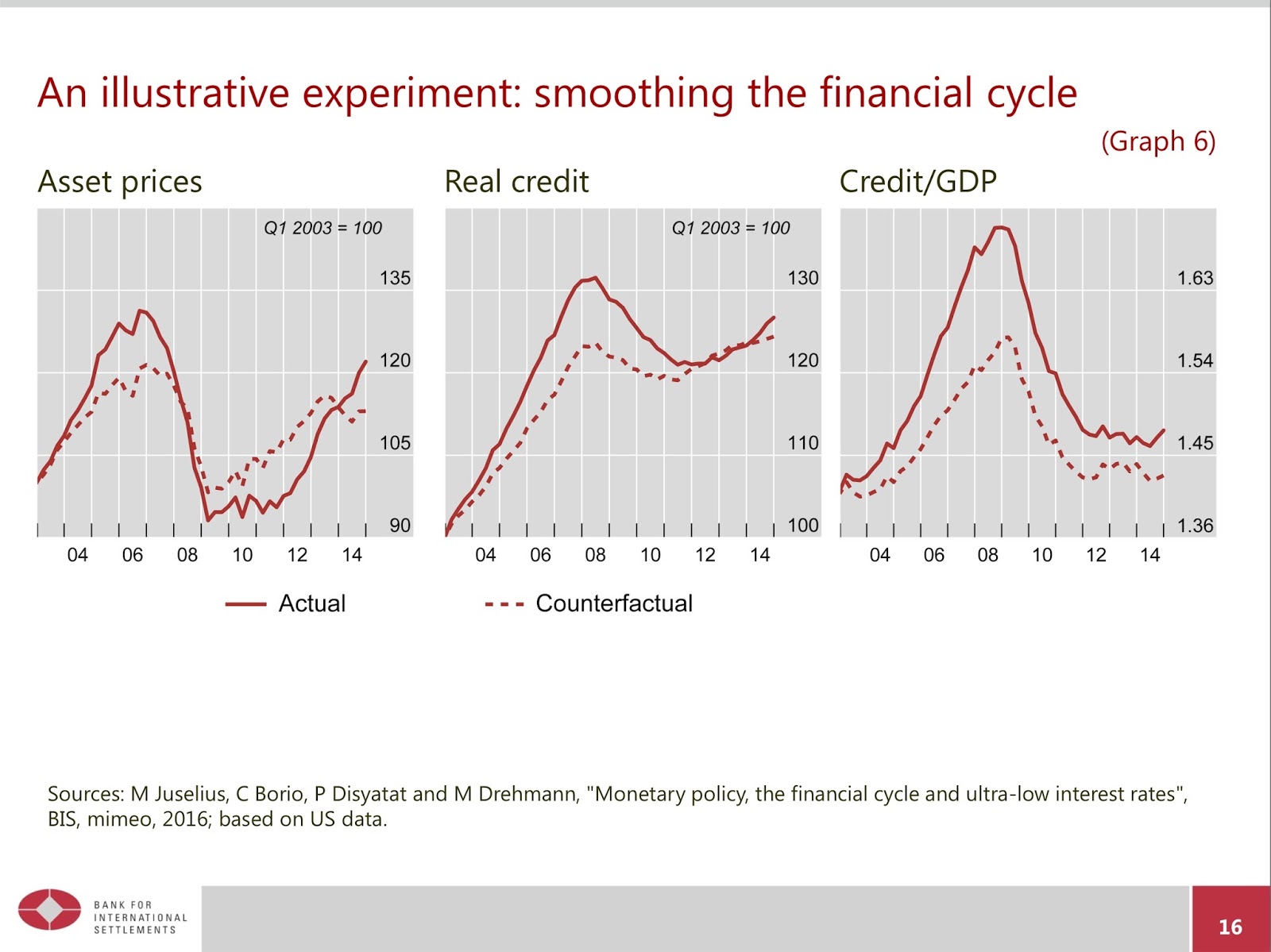
The crisis followed. Too much money was lent at these low rates. Too many resources were mis-allocated in a world where money was mis-priced. Here's what the BIS' experiment in setting policy to smooth the financial cycle throws out. A cycle, just not nearly such a pronounced one.


After the financial crisis and recession, the misallocation of resources that the financial boom caused/exacerbated, has led to a productivity-free economic recovery, at least in the economies most directly affected. So, estimates of natural rates have come down further. And since there's slack in the global economy, especially if we measure it on the basis of inflation undershooting expectations, policy rates fall even further. The possibility that the inflation cycle is a function of technology and the growth of global markets in goods and labour, is at most only considered in passing.

The depressing thing about this argument, is that the obvious conclusion would be that after a while we're just going to get washed way by another financial boom/bust cycle. Maybe not one whose epicentre is in the US and the UK to quite the same extent as the last one was, but that would be small comfort. It would be better to set global monetary policy with debt levels in mind, before the overall global debt/GDP level gets too much higher.


Sunday, 24 April 2016

Immigration, inequality and conceptual art

The Tate has a new exhibition called 'Conceptual Art in Britain 1964-1979' http://www.tate.org.uk/whats-on/tate-britain/exhibition/conceptual-art-britain-1964-1979 if you're interested.  A BBC Radio 4 reviewer explained carefully that conceptual art is all about the concept! One of the exhibits is of a glass of water that the artist explains has been changed into an Oak Tree.

Economics is about concepts  - notions, ideas, some of them rather abstract - and the economics of inequality is one of the most important ones. Thomas Piketty's "Capital in the 21st Century" captured the mood and helped spur a huge debate about its causes and the remedies that policy-makers should or shouldn't adopt. But at 700 pages long, it wasn't an easy read. Branko Milanovic's new book "Global Inequality, A New Approach for the Age of Globalization" comes in at 299 pages and the last 34 of those are the references and the index. It's also a book with great charts, so that the first time I opened it, I just skimmed through the picture with a cup of coffee.  For those two reasons alone, anyone interested in the economics of inequality should buy it (and read it).

There is a third, rather more serious reason,to be interested in the book. Thomas Piketty's focus was on how wealth inequality in particular grew in developed economies over time, and what policy-makers should do about it. The market, in his opinion, has and will feed widening inequality. Mr Milanovic's focus is on income not wealth and on global not national trends and is far more relevant to the world we find ourselves in. Martin Wolf reviewed the book more seriously here and talked about in a speech he gave for the Toynbee Foundation a couple of weeks ago.

The chart that Mr Milanovic is most famous for makes an appearance on the second page of the first chapter. It shows changes in income over 20 years plotted against income levels and can be loosely divided into four segments. On the left, the very poor are mostly in Africa (though you can reasonably throw Yemen, Afghanistan, even Pakistan and by now, Syria into this pot as well).  The middle of the chart shows income growth for average/below-average income groups many of whom are in newly-developed economies, notably in Asia. The group in the the 70-90th percentiles of global income levels are the poor/median income groups in developed western economies (they're  being left behind)  and the far right grouping is the top 5%, or the 1%.


The second chart shows the distribution of incomes in 1998 and 2011. Average incomes have gone up, but are still low by the standards of developed western economies. And the lack of growth in incomes in the 20-40,000 (2005) dollars per annum range is very apparent.

Apart from suggesting this is a book worth reading, I'll make a couple of observations. The first is that the reduction in global inequality levels isn't evenly-distributed; a lot of people, a lot of whom live on the other side of the Mediterranean, have been left behind. And secondly,  the political debate in developed economies is going to be shaped by how the lack of growth in median/below-median incomes is tackled.

My generation has grown up with the effects of booming trade - imported goods are cheaper and industries which can't compete in the global market-place have withered. The Philips Curve has creaked and groaned in the face of a global labour market and the profit share of GDP has boomed on the back of lower labour costs. As the UK debates how (or even, whether) to keep the last bits of its steel industry alive, the issue hasn't gone away but now the main talking point is immigration, almost everywhere. It's the single biggest political issue in both Europe and the US. It fuels the 'Brexit' voters' ranks, it holds up support for Nigel Farage, Marine Le Pen  and of course, Donald Trump. Meanwhile, those 1988-2008 charts don't even try to capture earnings gap that years of QE have opened up.

The failure of developed economies to tackle the humanitarian crisis in Syria (or Libya) before mass migration took over is miserably depressing. The response to the tide of refugees arriving on our shores over the last year, equally so. But even beyond the conflict zone, migration is  globalisation's response to global economic inequality. The poor and oppressed of the world are going to go on moving and between them, the advance of technology and the aftermath of the global commodity boom, they'll go on fuelling inequality within developed economies and all the political baggage that comes with that. Maybe that won't result in Trump becoming President, or the UK voting to leave the EU, or Marine Le Pen making a serious push for power. But without structural reform aimed at boosting the earning power of median income earners in developed economies, major victory for an anti-immigration, anti-free trade, anti-liberal party in a developed economy near you and me, is inevitable within the next 5 years or so.

Branko Milanovic doesn't make friends with all his opinions. But then, nor does Thomas Piketty and that hasn't stopped him from becoming an economics superstar. Income inequality is more important than wealth inequality and global inequality is more interesting in a global economy than only looking at national trends. Meanwhile, as for forecasts of median wage growth in high-income economies, well that's going to be a function of political choices, rather than Phillips Curves, isn't it! 

Sunday, 3 April 2016

25 multinationals and a big fat deficit

Awful balance of payments data fuel all sorts of responses - the UK doesn't make or export enough, or consumes too much. Is reliant on the kindness of strangers to finance the deficit, (Mark Carney) and is need of foreign direct investment that in turn probably depends on staying in the EU (David Smith). All fine arguments. But the surge in the  deficit in recent years is largely a result of the falling foreign income of a handful of huge multinational companies, whose incomes have fallen step by step with falling commodity prices. They finance themselves in international markets and are owned by international shareholders: Does that make a difference?

Heading for £100 per annum.... an awfully big hole 
The UK’s current account deficit reached £32.7bn in Q4 2015, which equates to 7% GDP and is the biggest deficit since records began. It takes the annual deficit to £96.2bn, 5.2% GDP. The £12.6bn deterioration from Q3 to Q4 was due to a £3.3bn increase in the deficit in goods and services to £12.2bn, a £2bn increase in the deficit in secondary income to £5.4bn and a £7.3bn increase in the deficit on primary income, to £13.1bn. It’s worth noting in passing that the UK’s net investment position now is in liability to the tune of £65,9bn, In other words, foreigners own £65.9bn-worth of UK assets more than UK investors own of foreign assets. All other things being equal over time, the bigger the net liability, the bigger the net investment income deficit will be.

The ONS’ chart of the overall make-up of the current account balance is below.


The trade account includes goods (a deficit) and services (a surplus). It's been pretty steady in recent years, though still significantly in deficit. The secondary income balance includes transfers provided with no expectation of payment, so things like bilateral aid and of course, payments to or from the EU. This series is volatile on a quarterly basis but not so much over a longer period. The primary income balance includes compensation of staff, rents, taxes and most of all, investment income.  Here’s a chart of that, and its constituent parts:


The primary income balance was in surplus as recently as mid-2013 and just glancing at the chart you can see that its deterioration coincides with a dramatic shift in the balance of direct investment income. The ONS took the trouble to publish an article to  explain what’s going on and the link is here: https://www.ons.gov.uk/economy/nationalaccounts/balanceofpayments/articles/ananalysisofthedriversbehindthefallindirectinvestmentearningsandtheirimpactontheukscurrentaccountdeficit/2016-03-31

If reading it all is too much bother on a sunny Sunday morning, the main points are as follows:

More than 80% of the deterioration in the current account since 2011is attributable to falls in net foreign direct investment (FDI) earnings.

Falling FDI credits over this period explain just under 80% of the decline in net FDI earnings, and the majority of that is attributable to the largest 25 multinational companies. This partly reflects the fact that UK FDI assets are exposed to movements in global commodity prices – most notably crude oil.

In my day job, I mostly ignore these niceties. The current account deficit is huge and leaves the UK dependent on foreign investors’ confidence in and appetite for UK assets. In the middle of a toxic debate about whether or not to remain in the EU, that’s bad for confidence and particularly bad for the pound. I’ve written extensively on that and the pound has indeed, fallen sharply in recent months and since the latest data were released.

Questions
But two questions are posed by the data. The first is whether we will see the current account deficit recover as an when oil and other commodity prices stabilize (or bounce)? The second is whether what 25 big multinationals do matters at a national level?

The UK still had a current account deficit, albeit a smaller one, when the commodity boom was in full flight. So in 2011 when the deficit was 1.7% GDP and commodity prices were at their peak, the headline figure masked the poor underlying  situation. Q4’s 7% deficit may overstate how bad things are, but I could average between the 1.7% of 2011 and the 5.2% of 2015 and conclude that 3 ½% GDP is a truer reflection of the underlying position. And that’s only small comfort. It’s still, in today’s money, an annualized international borrowing need of GBP 65bn.

I might be tempted to say that the UK’s £65bn underlying deficit is just the other side of the coin with regard to the Eurozone's near-£200bn current account surplus.

I might also conclude that the commodity cycle is far more volatile than FX trends, and so the idea that a weaker pound will magically solve the UK’s balance of payments problems is absurd. It would improve them a bit, but the parts that have caused the deterioration are not terrible senstivie to sterling exchange rates.

But are big global companies different? 
The second question is more difficult. Imagine a large UK-domiciled multi-national that used to earn huge amounts on its foreigh investments, but is now no longer doing so as a result of falling oil prices. So, instead of repatriating income and paying a dividend to its (global) shareholders, it will borrow money or run down cash reserves until prices recover. ,It may well also save money by reducing employment overseas, which helps improve the situation on the balance of payments without having much impact on the UK economy. If it borrows by issuing debt, does that really have much impact on the UK? Once upon a time a large UK multinational issuing sterling bonds might have been considered to squeeze out other buyers of gilts, say, but I’m not even sure that’s a relevant factor anymore.

I’m not going to argue this doesn’t affect the national accounts – it does.  A multinational that earns money abroad is bringing pounds back home and one that issues debt is adding to the demand the rest of the UK makes on the global investor community. But to what degree does a multinational borrowing money really squeeze out the UK Government? To what extent does paying dividends to global shareholders boost the UK? And while huge changes in commodity prices have clearly been a driver of the direct investment income balance, it’s also true that whether a company reinvests in its foreign businesses, or brings cash home, is a decision determined by all sorts of factors, with international tax regulations  often at the top of the pile.

All this is framed as a question and that’s why this is a blog rather than an investment bank's sell-side research note. I’m not sure I’m aloud to write ‘I don’t know’ this often in the day job!  The UK’s 7% GDP current account deficit is frankly, embarrassingly huge. There are no positives in the data but if someone asks just how hard it will be to find foreign financing for the defiit, and whether it will go on growing in the years ahead, all I can really say is that I don’t know, because that depends on the decisions of the management of a couple of dozen huge global  companies who may think that this is a good time to be borrowing at super low rates, even if that does drive the UK’s current account deficit up.